
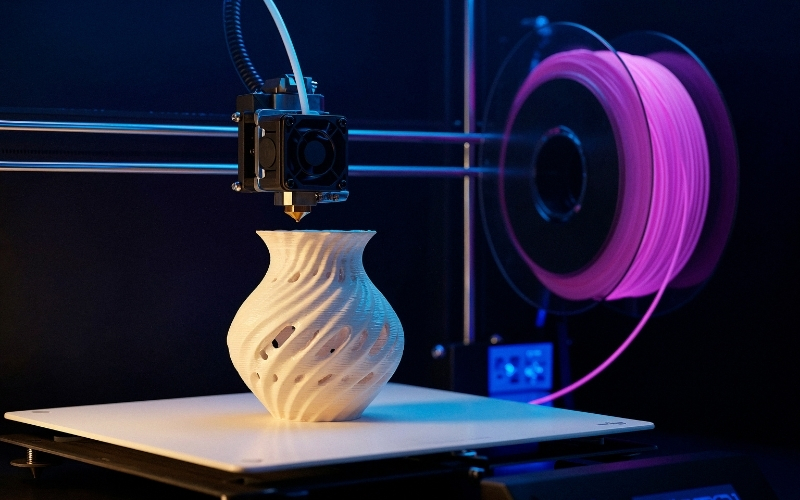
3D printing is one of the most exciting technological innovations of the modern era. It has completely changed the way products are designed, developed, and manufactured. Instead of traditional methods that involve cutting, molding, or shaping materials, 3D printing builds objects layer by layer directly from a digital file.
This revolutionary process is also known as additive manufacturing, and it is transforming industries such as healthcare, automotive, aerospace, fashion, education, and even food production.
But how does it actually work, and why is it so powerful? Let’s explore in detail.
What is 3D Printing?
3D printing is a manufacturing process where physical objects are created from digital designs. A special machine called a 3D printer reads a computer-generated model and produces the object by adding material layer upon layer until the final shape is formed.
Unlike traditional manufacturing, which often removes material (subtractive manufacturing), 3D printing adds only what is needed. This makes it more efficient, precise, and customizable.
How Does 3D Printing Work?
The process of 3D printing involves several key steps:
1. Designing the Model
Everything starts with a digital design created using Computer-Aided Design (CAD) software. This model defines the shape, size, and structure of the object.
2. Converting the File
The CAD file is converted into a format that the printer can understand. It is then sliced into thin horizontal layers using slicing software.
3. Printing the Object
The 3D printer reads these layers and starts building the object from the bottom up. Each layer is carefully deposited on top of the previous one.
4. Finishing Process
Once printing is complete, the object may require cleaning, polishing, or curing depending on the material used.
This step-by-step process allows even the most complex designs to become reality.
You Can Also Read : Unlocking Creativity: Mastering SketchUp Free for Stunning 3D Designs
Types of 3D Printing Technologies
Different 3D printing technologies are used depending on the purpose and material:
1. FDM (Fused Deposition Modeling)
This is the most common type of 3D printing. It melts plastic filament and builds objects layer by layer. It is widely used for prototypes and basic models.
2. SLA (Stereolithography)
This method uses liquid resin that is hardened using ultraviolet (UV) light. It produces highly detailed and smooth objects.
3. SLS (Selective Laser Sintering)
This technology uses a laser to fuse powdered materials like nylon or metal. It is ideal for strong and functional parts.
Each method has its own strengths depending on accuracy, cost, and durability requirements.
Materials Used in 3D Printing
3D printing supports a wide range of materials, including:
- Plastics (PLA, ABS) – commonly used for prototypes and everyday objects
- Resins – used for high-detail models
- Nylon – strong and flexible material for industrial use
- Metals – used in aerospace and automotive parts
- Biomaterials – used in medical research and bioprinting
One of the most advanced developments is bioprinting, where living cells are used to create tissues and organs for medical applications.
You Can Also Read : 2-Way vs 4-Way Speakers: Which Sounds Better?
Applications of 3D Printing
3D printing is no longer limited to laboratories or industrial use. It is now used across many industries:
Healthcare
- Custom prosthetics
- Dental implants
- Surgical models
- Tissue engineering research
Automotive Industry
- Car prototypes
- Spare parts manufacturing
- Lightweight components
Aerospace
- Aircraft components
- Fuel-efficient lightweight designs
- Rapid prototyping for testing
Fashion & Jewelry
- Customized accessories
- Unique clothing designs
- Personalized jewelry pieces
Education & Research
- Learning models
- Engineering prototypes
- Scientific experiments
This wide range of applications shows how flexible and powerful 3D printing has become.
Advantages of 3D Printing
3D printing offers several important benefits:
- Cost-effective production for small batches
- Fast prototyping and product development
- High customization for individual needs
- Less material waste compared to traditional methods
- Complex designs made easy
These advantages make it highly valuable for modern industries.
Challenges of 3D Printing
Despite its benefits, 3D printing still faces some challenges:
- High cost of advanced printers
- Limited material options for some industries
- Slow production for large-scale manufacturing
- Need for skilled operators and designers
- Legal and safety regulations still evolving
As technology improves, many of these limitations are expected to reduce over time.
Future of 3D Printing
The future of 3D printing is extremely promising. Experts believe it will play a major role in reshaping global manufacturing.
Some key future trends include:
- On-demand local manufacturing
- Fully customized consumer products
- Advanced bioprinting for organ development
- Space manufacturing for missions and habitats
- Sustainable production with minimal waste
It is even predicted that 3D printing could become a standard household technology in the future.
If you are a writer with strong knowledge of technology and a passion for sharing insights, submit your guest post on tech and help educate and inspire a wider audience with your ideas and expertise.
Conclusion
3D printing is not just a technological advancement—it is a complete shift in how we create and manufacture objects. From simple prototypes to life-saving medical applications, its impact is already visible across the world.
As innovation continues, 3D printing will unlock even more possibilities, making production faster, smarter, and more personalized than ever before.
The journey into the world of 3D printing has only just begun, and its future is filled with endless opportunities.