
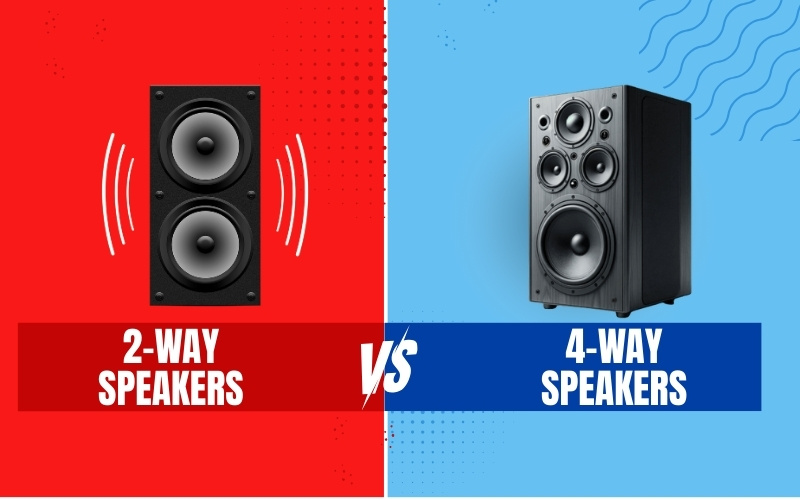
Choosing the right speakers can feel confusing, especially when you’re faced with terms like 2-way and 4-way speakers. While both are designed to deliver great audio, they work differently and suit different listening needs. Understanding how each type functions will help you pick the speaker that truly matches your sound expectations.
What Are 2-Way Speakers?
A 2-way speaker uses two dedicated drivers to handle sound:
-
Tweeter – produces high-frequency sounds like vocals and cymbals
-
Woofer – handles low and mid-range frequencies such as bass and instruments
This simple design allows each driver to focus on its specific frequency range, resulting in clear and well-balanced audio.
Why people like 2-way speakers:
-
Clean and natural sound reproduction
-
Fewer components, which reduces distortion
-
Affordable and easy to install
-
Ideal for home audio systems and small rooms
What Are 4-Way Speakers?
A 4-way speaker divides sound across four drivers:
-
Tweeter – high frequencies
-
Mid-range driver – vocals and instruments
-
Woofer – low frequencies
-
Sub-woofer or super tweeter – very low bass or ultra-high tones
By splitting audio into more frequency ranges, 4-way speakers aim to deliver a fuller and more powerful sound.
Why people choose 4-way speakers:
-
Louder output with enhanced bass
-
More detailed frequency separation
-
Suitable for large rooms, cars, and outdoor setups
-
Ideal for listeners who enjoy bass-heavy music
Sound Quality: 2-Way vs 4-Way Speakers
When it comes to sound quality, more drivers don’t always mean better sound.
-
2-way speakers focus on accuracy and clarity. Because the design is simpler, the sound often feels more natural and balanced.
-
4-way speakers provide stronger bass and higher volume, but the added complexity can sometimes cause overlap between frequencies if not well-engineered.
For everyday listening, many people find 2-way speakers more pleasant and true to the original recording. For parties, cars, or high-energy music, 4-way speakers can feel more exciting and powerful.
2-Way vs 4-Way Speakers – Key Differences
| Feature | 2-Way Speakers | 4-Way Speakers |
|---|---|---|
| Number of Drivers | 2 drivers (woofer + tweeter) | 4 drivers (woofer, mid-range, tweeter, sub/super tweeter) |
| Sound Quality | Clear, balanced, and natural | Powerful, bass-heavy, and loud |
| Bass Performance | Moderate and clean | Strong and deep bass |
| Clarity & Accuracy | High clarity with less distortion | Good clarity but can vary by build quality |
| Loudness | Suitable for normal listening levels | Designed for higher volume output |
| Best Use Case | Home audio, offices, small rooms | Cars, parties, large rooms, outdoor use |
| System Complexity | Simple design with fewer components | More complex with multiple frequency divisions |
| Installation | Easy to install and maintain | May require more space and tuning |
| Power Requirement | Lower power consumption | Higher power requirement |
| Price Range | Generally more affordable | Usually more expensive |
| Ideal For | Listeners who value clarity and balance | Listeners who enjoy bass and loud sound |
Which One Is Better for Your Needs?
The “better” choice depends on how and where you’ll use your speakers:
Choose 2-way speakers if you want:
-
Clear vocals and natural sound
-
A compact and budget-friendly setup
-
Speakers for home, office, or casual listening
Choose 4-way speakers if you want:
-
Strong bass and loud sound output
-
A speaker system for large spaces or vehicles
-
An immersive, high-impact audio experience
Final Verdict
Both 2-way and 4-way speakers have their strengths. If sound clarity, balance, and simplicity matter most to you, 2-way speakers are an excellent choice. If you crave powerful bass and room-filling sound, 4-way speakers may be the better fit.
In the end, the best speaker isn’t about the number of drivers—it’s about how well it matches your listening style and environment. Choose wisely, and your ears will thank you